'An incredible period' ~ Edna Nwanunobi, teacher
Oriinally Published By BBC
‘An incredible period’ ~ Edna Nwanunobi, teacher
She was teaching English and French in a secondary school in Port Harcourt in southern Nigeria when the civil war began.
While the UK backed Nigeria, France was the most prominent supporter of Biafra.
But English was more widely spoken in Biafra, so translators were needed whenever French officials visited Ojukwu.
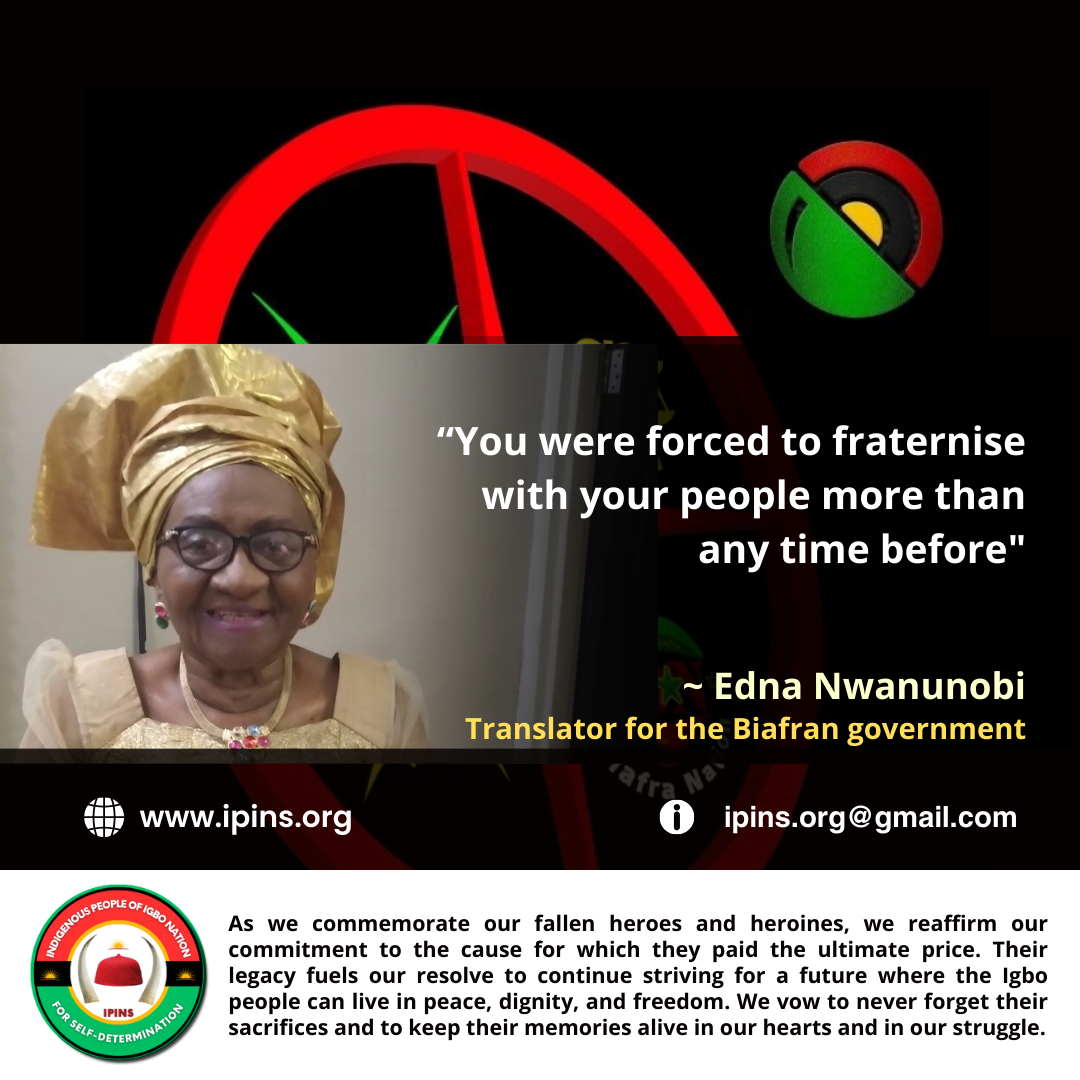
Ms Nwanunobi joined the Biafran ministry of foreign affairs as part of a handful of translators who worked directly with Ojukwu.
“The war was an incredible period,” said Mrs Nwanunobi. “Everybody was forced to go home so you were forced to fraternise with your people more than any time before.
“And people who worked in every Biafra office were high level people. These were people who were doing all sorts of things and the war forced them out of their positions.”
She enjoyed working directly with the Biafran leader, whom she and her colleagues fondly referred to as “Brother OJ”.
“He was a gorgeous person,” she said again and again. “And he was disciplined. If any meeting lasted more than two hours, he wouldn’t be party to it.”
Her most memorable assignment occurred after the Biafran military captured six Italian oil workers employed by the Nigerian government.
Officials from different European countries travelled to meet Ojukwu to appeal for their release.
“That was the largest assembly we had,” she recalled. “Even the Vatican sent representatives.”
During the meeting, Mrs Nwanunobi conveyed to Ojukwu that he stood the risk of losing European support.
He promised to consider the matter, and the Italians were subsequently released.
Mrs Nwanunobi met Ojukwu for the last time on 23 December 1969, when she lined up outside his office with her colleagues, to receive a Christmas gift and a handshake from him.
A few days later, she left the country for the Biafran office in Paris. During a stopover of several days in Lisbon, she heard that Biafra had surrendered.
Her first concern was for Ojukwu.
“I was worried that he would come to harm,” she said softly. “I didn’t want anybody to disgrace him.”
Her worry lifted when she learned that her boss had escaped in his private jet, and was granted asylum by Ivory Coast, a francophone country.
Mrs Nwanunobi spent much of the 1970s in Canada before returning to Nigeria in 1977, where she resumed work as a secondary school teacher.
Ojukwu himself remained in exile for 13 years. After he was officially pardoned by the Nigerian government, he returned in 1982, with multitudes pouring onto the streets of his home state of Anambra to welcome him.
He died in November 2011 and was given a full military burial in a ceremony attended by then Nigerian President Goodluck Jonathan, some other African leaders and members of the diplomatic corps.
Fifty years after the Biafran conflict, Nigeria is still battling to maintain its unity, with various groups, not just the Igbo, calling for the restructuring of Africa’s most populous state.
It is probably for this reason that the war is barely mentioned.