Originally Published By Authority
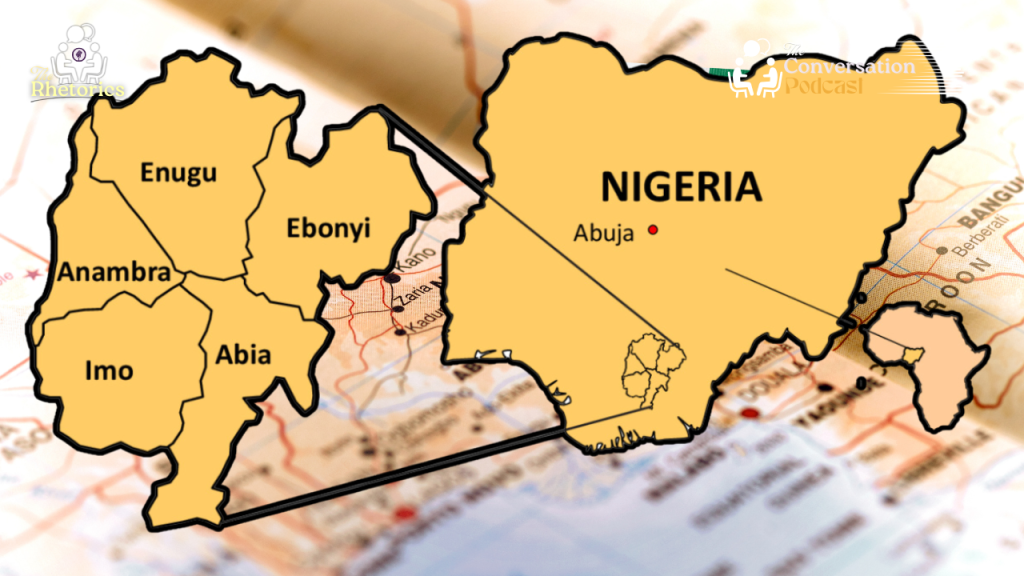
The Igbo people of Nigeria’s South-East region have endured decades of systemic oppression, marginalization, and state-sponsored violence, all justified under the guise of maintaining Nigeria’s territorial integrity. These enduring injustices compel a moral and legal demand for a free and impartial plebiscite, overseen by the United Nations (UN).

Such a referendum would allow the Igbo people to exercise their fundamental right to self-determination, determining whether to remain within Nigeria or chart their course as an independent nation.
NIGERIA’S WEAPONIZATION OF TERRITORIAL INTEGRITY
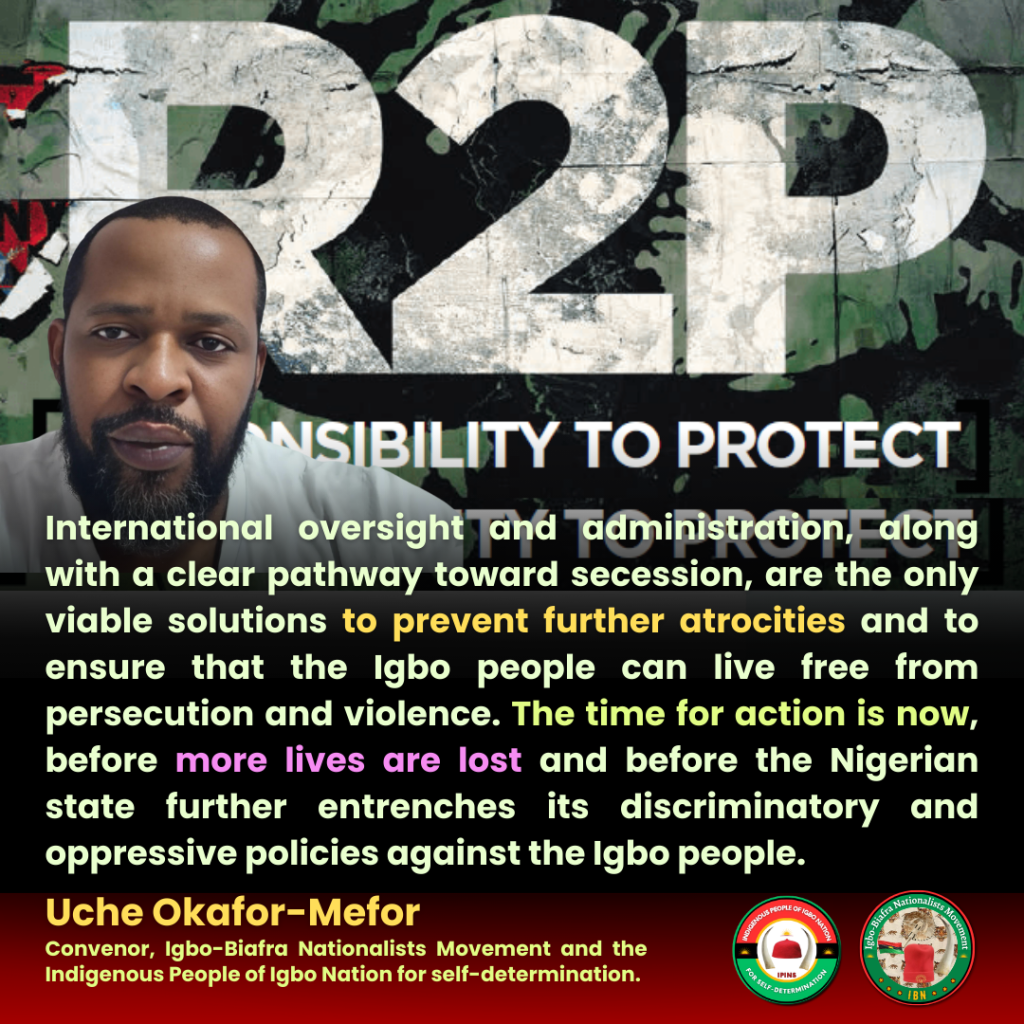
Nigeria has weaponized the principle of territorial integrity to suppress legitimate calls for Igbo self-determination and to justify widespread human rights abuses. While international law respects territorial sovereignty, it does not permit states to use it as a shield for crimes against humanity, such as extrajudicial killings, mass arrests, and systemic persecution, or for ethnic cleansing, as evidenced by the state’s violent actions against Igbo communities in the South-East. As Uche Mefor, Convenor of the Igbo-Biafra Nationalists and the Indigenous People of Igbo Nation for Self-Determination, asks: For how long will Nigeria exploit the principle of territorial integrity to unleash monumental human rights violations on the Igbo people?
HYPOCRISY IN NIGERIA’S TERRITORIAL CLAIMS
Nigeria’s insistence on the inviolability of its territorial integrity is undermined by its own actions, which reveal a pattern of selective and self-serving application. In compliance with the International Court of Justice (ICJ) ruling in 2002, Nigeria willingly relinquished the Bakassi Peninsula to Cameroon through the Green Tree Accord in 2006. This act underscores that Nigeria’s territorial claims are not sacrosanct and can be adjusted through legal and diplomatic processes.
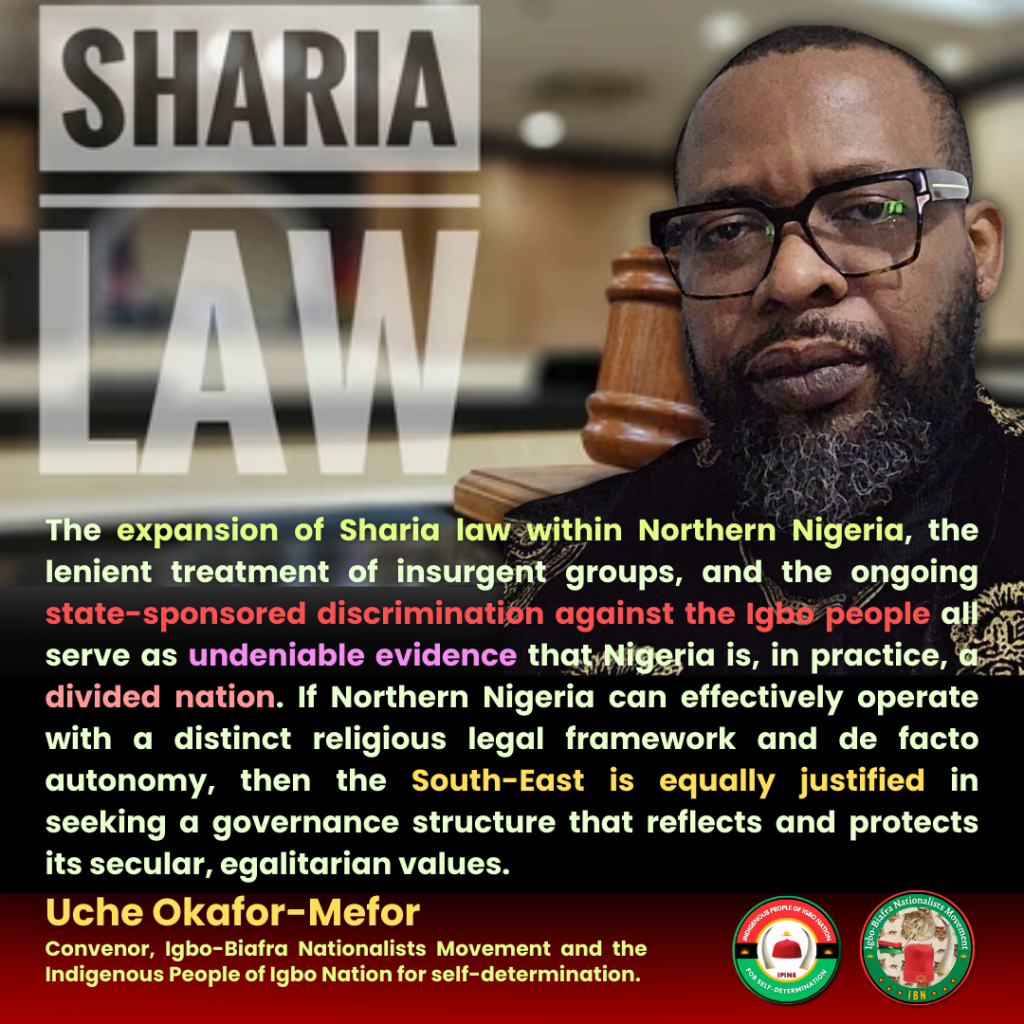
Furthermore, northern Nigeria’s adoption of Sharia law is effectively a de facto secession, granting substantial autonomy to the region while the South-East is denied similar rights. This blatant inequality demonstrates Nigeria’s selective recognition of self-determination, further marginalizing the Igbo people. These precedents invalidate Nigeria’s claim of absolute sovereignty when it comes to the South-East and strengthen the case for a plebiscite to address the Igbo people’s aspirations.
SUPPRESSION OF IGBO SELF-DETERMINATION
The Nigerian government has actively suppressed the Igbo people’s attempts to seek justice, equality, and autonomy. The Igbo are systematically excluded from substantive, meaningful, influential national leadership roles and subjected to deliberate economic disenfranchisement. Military aggression against the South-East has led to atrocities, including the killing and imprisonment of Igbo youths under the guise of counterinsurgency. Unlike the North’s autonomy under Sharia law, the South-East’s calls for regional self-rule or restructuring are repeatedly dismissed. This unyielding repression leaves the Igbo people with no viable option but remedial secession, which can only be legitimized through a UN-supervised plebiscite.
THE LEGAL FOUNDATION FOR IGBO SELF-DETERMINATION
The Igbo people’s demand for self-determination is firmly grounded in international law. The UN Charter recognizes the right of peoples to self-determination as a cornerstone of global peace and justice. Similarly, the International Covenant on Civil and Political Rights (ICCPR) affirms the right of all peoples to freely determine their political status, and the African Charter on Human and Peoples’ Rights explicitly states that all peoples have the right to existence and self-determination. Nigeria’s repeated failure to adhere to these principles underscores the legitimacy of the Igbo people’s demand for international intervention.
THE RESPONSIBILITY TO PROTECT (R2P)
The international community has a duty under the Responsibility to Protect (R2P) doctrine, adopted at the 2005 UN World Summit, to intervene when a state fails to protect its citizens from genocide, war crimes, ethnic cleansing, and crimes against humanity. The atrocities committed by the Nigerian state in the South-East, including targeted killings, systemic repression, and ethnic cleansing of Igbo youths, demand urgent international action under R2P.
A UNITED NATIONS-SUPERVISED REFERENDUM
A UN-supervised plebiscite offers the most democratic and peaceful solution to the South-East crisis. UN oversight guarantees a transparent process free from Nigerian state interference or manipulation. An internationally recognized referendum lends credibility to the outcome, ensuring global acceptance, and a democratic resolution reduces the risk of prolonged conflict and instability.
THE SOUTH-EAST MEETS THE MONTEVIDEO CRITERIA FOR STATEHOOD
The South-East region and other Igbo territories fulfill the requirements of the Montevideo Convention (1933) for statehood. The Igbo people form a distinct and cohesive ethnic group with shared cultural, linguistic, and historical ties. The South-East is geographically and historically recognized as the Igbo homeland. The region has demonstrated its capacity for governance through effective community leadership and administrative structures. The Igbo people also possess the intellectual, economic, and social resources to engage with the international community effectively. These criteria affirm the readiness of the South-East region to function as a sovereign state, should the plebiscite determine such a course.
CALL FOR JUSTICE AND GLOBAL ACTION
The Igbo people’s demand for a free and impartial plebiscite is not an act of rebellion but a legitimate pursuit of justice, dignity, and self-determination. By facilitating this process, the United Nations can uphold its commitment to human rights, protect vulnerable populations, and provide a framework for resolving similar conflicts worldwide.
The Igbo people have suffered too long under an oppressive system that denies their humanity, rights, and future. A UN-supervised referendum is the only viable pathway to peace, justice, and self-determination for the South-East region. The time to act is now. Let the Igbo people determine their destiny.